Practical Sustainability For physics based, Non-chemical Water Treatment Programs
Our story
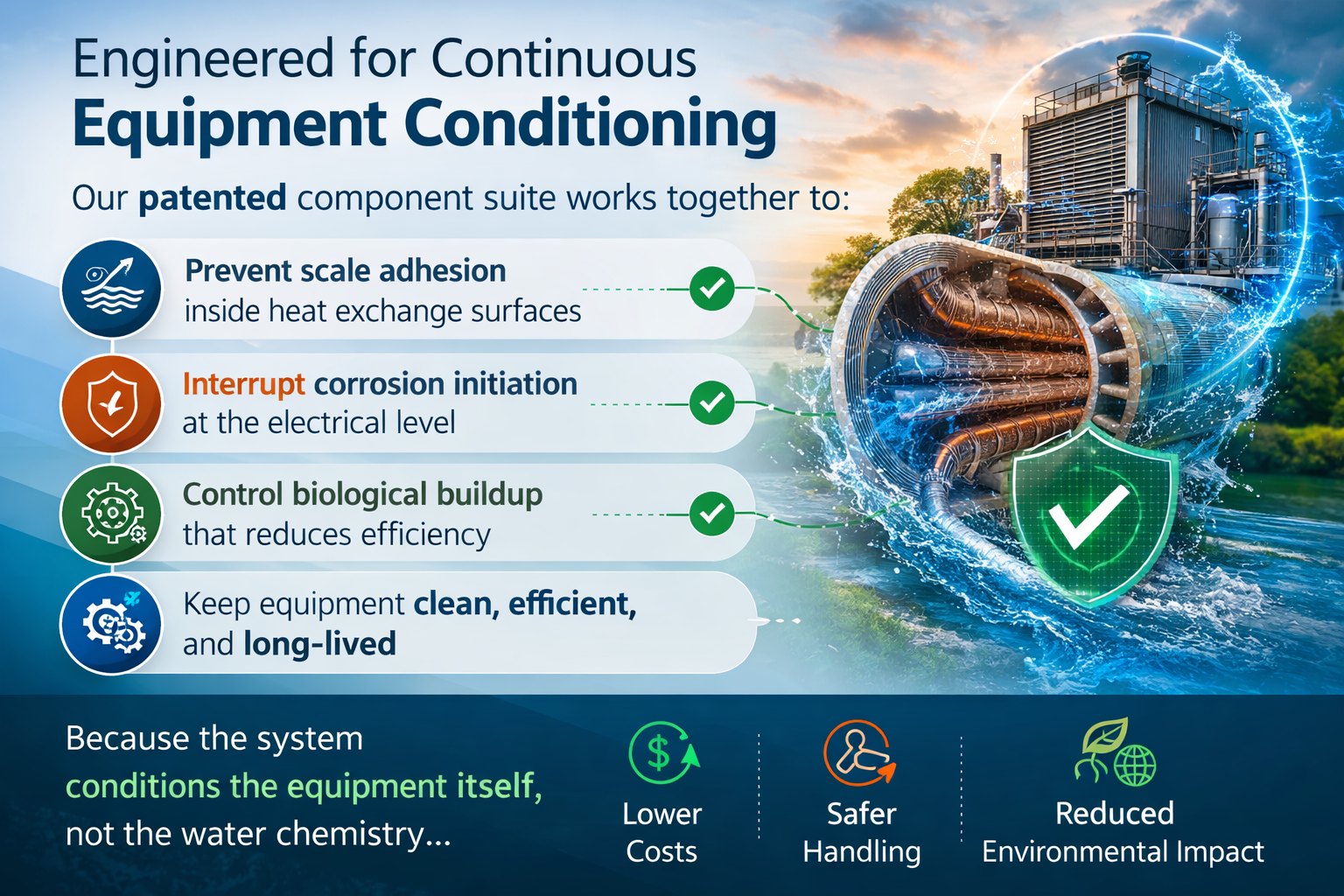
Implementing the Scale Free System on heat transfer equipment immediately reduces a facility’s environmental impact by eliminating the need for conventional chemical treatment programs. For organizations operating under sustainability mandates, this physics-based approach enables measurable reductions in chemical handling, discharge, and regulatory burden while delivering tangible operational savings.
By removing chemicals from the treatment process, discharge water becomes suitable for on-site reuse, supporting higher cycles of concentration and significantly reducing overall water consumption. This improves system efficiency while lowering utility and operating costs.
In addition to its performance benefits, the Scale Free System mitigates the inherent risks associated with chemical programs—including accidental spills, personnel exposure, and the long-term environmental impact of persistent compounds. The result is a safer, more controlled operating environment with a materially lower environmental footprint.
Materials, Toxic Substances and Waste
The reuse of materials is a sustainable practice that is rapidly growing. As global population and affluence has increased, so has the use of various materials increased in volume, diversity and distance transported. Included here are raw materials, minerals, synthetic chemicals (including hazardous substances), manufactured products, food, living organisms and waste.
Sustainable use of materials has targeted the idea of dematerialization, converting the linear path of materials (extraction, use, disposal in landfill) to a circular material flow that reuses materials as much as possible, much like the cycling and reuse of waste in nature. This approach is supported by product stewardship and the increasing use of material flow analysis at all levels, especially individual countries and the global economy.
Synthetic chemical production has escalated following the stimulus it received during the Second World War Chemical production includes everything from herbicides, pesticides and fertilizers to domestic chemicals and hazardous substances. Apart from the build-up of greenhouse gas emissions in the atmosphere, chemicals of particular concern include: heavy metals, nuclear waste, chlorofluorocarbons, persistent organic pollutants and all harmful chemicals capable of bioaccumulation. Although most synthetic chemicals are harmless there needs to be rigorous testing of new chemicals, in all countries, for adverse environmental and health effects. International legislation has been established to deal with the global distribution and management of dangerous goods.
Every economic activity produces material that can be classified as waste. To reduce waste industry, business and government are now mimicking nature by turning the waste produced by industrial metabolism into resource. Dematerialization is being encouraged through the ideas of industrial ecology, ecodesign and ecolabelling. In addition to the well-established "reduce, reuse and recycle," shoppers are using their purchasing power for ethical consumerism.
Sustainable Solutions Impact The Environment, Economy and Society
Sustainability is the ability to operate today without compromising the future. For businesses, it means maintaining long-term performance while responsibly managing environmental, economic, and social impact.
At its core, sustainability is stewardship—how effectively you manage your resources, protect your people, and operate within the environments and communities you serve.
Across industries—from manufacturing and healthcare to food service, hospitality, and education—organizations have both the opportunity and responsibility to reduce their impact while improving operational efficiency. Sustainable practices are not just environmental decisions; they are business decisions that influence cost, risk, compliance, and long-term viability.
Sustainability touches every part of your operation—from sourcing and production to system performance, water use, and energy consumption. Forward-thinking facilities are adopting technologies and strategies that reduce resource demand, eliminate waste, and improve system longevity.
True sustainability exists at the intersection of three key factors:
Environmental Responsibility – Reducing resource consumption and environmental impact
Economic Performance – Lowering operating costs and improving efficiency
Social Impact – Protecting people, communities, and workplace safety
These pillars are not independent—they reinforce one another. When implemented correctly, sustainable systems drive both operational performance and environmental outcomes.
For modern facilities, sustainability is no longer optional—it is a strategic requirement.